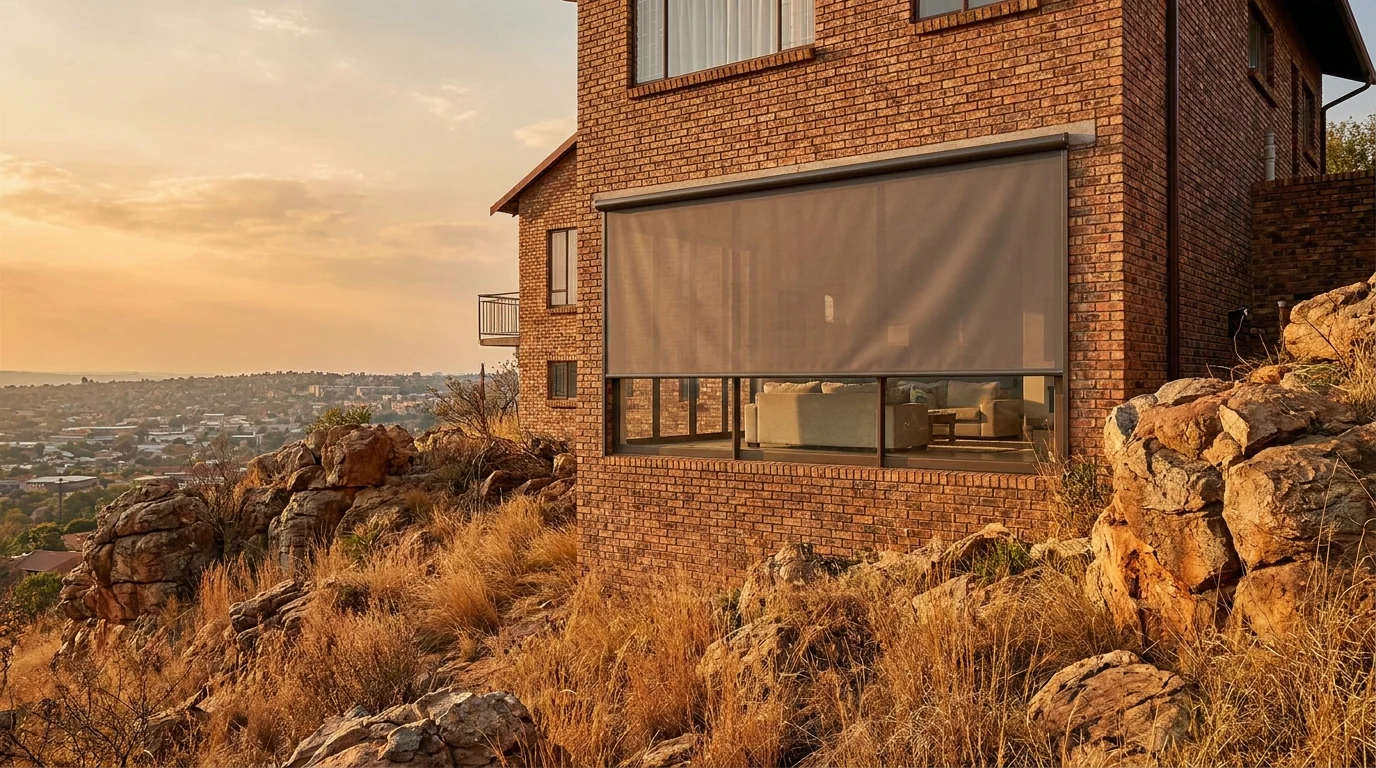
A face-brick home built into the Northcliff ridge at golden hour, a sunscreen roller blind lowered halfway across the living-room window, the Johannesburg skyline spread out below the exposed koppie rock
Free area guide · Northcliff Ridge

The Four O'Clock LineThe Northcliff ridge window field guide

What the Highveld sun actually does to a house built to face the view — elevation by elevation, with the trade-offs written down instead of glossed over.

About 9 minutes to read Written August 2026 Free, and nothing is gated Sources at the foot
In this guide Why the ridge is different What the light does Elevation by elevation What we'd fit, and the catch Boom gates & renovations What we'd check on site Your two ways forward Sources
01 — The starting point

Why a house built to face the view needs its own shading brief

Northcliff was established in 1934, terraced up a rocky ridge that — at 1,807 m — is the second-highest point in Johannesburg, a metre short of Observatory Ridge.[1][2] The 1939 water tower on the crown of the hill still marks it from the trails of Northcliff Ridge Ecopark, the exposed koppie rock and indigenous grassland the suburb is built into.[3][4] Cresta Shopping Centre borders the area, with the N1 and Beyers Naudé Drive the main routes in and out.[5]

Three things about a ridge suburb change how a blind gets specified.

The house is built to face the view, not away from the sun. Northern-slope stands are prized for a warmer, sunnier winter; stands higher up orient primarily toward the panoramic outlook, which for many properties means full-height glazing with little natural shading.[1] The same glass that frames the skyline takes the sun straight on.

Streets step, they don't run flat. Narrow, winding roads climb the slope with low garden walls angled to preserve the view line, driveways and retaining walls doing much of the work on the steeper sections; some streets now run boom-gate access control.[1]

Housing stock is mixed, not uniform. Resale stock blends original face-brick homes — many renovated with modern glass extensions — with contemporary rebuilds.[1] Two houses on the same street can carry two different generations of window, which is why a quote starts with an on-site measure, not a guess from a floor plan.

02 — The light here

What the sun actually does over the ridge

Johannesburg sits at roughly latitude 26.2°S. The clearest published South African sun-path work, calculated for Pretoria about 50 km north — the difference in solar angles versus Johannesburg is well under a degree — puts the sun 87.7° above the horizon at solar noon on 21 December and only 40.84° on 20 June.[6] A calculation done directly for Johannesburg cross-checks it almost exactly: about 87.2° in December, 40.4° in June.[7]

That 47-degree swing plays out differently depending which way a stand's view glass faces. In midsummer the noon sun sits nearly overhead, so even a modest overhang shades a window at midday. By June it has dropped to about 41°, pushing winter warmth deep into north-facing glass — welcome, on a ridge where the wind takes heat away about as fast as the sun delivers it.

The problem is the long afternoon. On 21 December the sun sets on a bearing of 243.35° — about 27° south of due west — and the study behind that figure is blunt: afternoons on a west-facing elevation run far hotter than the mornings.[6] From about three o'clock the sun arrives almost horizontally, and no overhang above the glass blocks a horizontal ray. On a stand where the panoramic outlook runs anywhere from north-west through to west — most of the ridge's view-facing glass — shading has to sit at the window or outside it, never above it.

Two more facts that change the specification

  • Rain arrives as storms, not drizzle. July is Johannesburg's driest month, at around 3.6 mm; December is wettest, at roughly 140 mm out of about 779 mm a year[8] — and hail is most common between October and March, peaking around November, most frequent from early afternoon into early evening.[9] The Highveld is especially prone to intense afternoon and evening thunderstorms in that window.[10] Anything left extended over a deck needs to sense the wind and retract before the storm arrives, not after.
  • Altitude, and the UV that comes with it. The Highveld sits 1,200–1,800 m up — Northcliff Ridge, at 1,807 m, sits right at the top of that band.[11] Cloudless plateau skies plus altitude mean high ambient UV, rising roughly 10% per 1,000 m of elevation.[12] Fabric on the view side of a ridge house earns its keep specified on UV performance first, colour second.
03 — Room by room

Elevation by elevation, and which rooms suffer

One house, four problems — and on a ridge stand, the first job is confirming which wall actually carries the view glass.

North — where winter warmth lives, if the stand catches it

North is where the sun sits all winter: nearly overhead at midsummer, then down at about 41° and pouring in by June.[6] Northern-slope stands are the ones prized for a warmer winter for exactly this reason.[1] Rooms here want something you can angle — summer light bounced up and away, opened flat again once the weather turns. A blockout roller is a blunt instrument on this wall.

Verdict: adjustable beats absolute.
West — the elevation that costs you the afternoon

Low, near-horizontal sun from about three o'clock, from 27° south of due west at midsummer.[6] On a stand oriented toward the panoramic outlook, this is usually the same wall the view lives on — the lounge, the deck doors, the room the house was designed around. If it's unbearable by four, the glass itself is heating and radiating inward, so an interior blind fixes the glare at once and the heat only partly.

Verdict: stop it outside the glass if you can; a proper sunscreen if you can't.
East — a hard, short glare, not a heat problem

The same low-angle geometry mirrored, into a house that cooled overnight — sharpest on bedrooms and kitchens catching the first sun over the ridge. It's an hour of hard glare rather than an afternoon of heat, so blockout in the bedrooms and something see-through in the kitchen usually covers it.

Verdict: solve for glare and sleep, not for heat.
South — steady light, cold mornings, and whatever the ridge does to the wind here

Almost no direct sun most of the year, so south rooms hold the steadiest light in the house and the coldest mornings. Shading is rarely the problem; heat loss through older single glazing usually is, which is what a cellular honeycomb blind holding still air against the pane is good at. A stand sitting close to the exposed rock and grassland of the ridge crest is also likely to be more wind-exposed than one tucked lower on the slope — worth flagging, not something we'll claim to have measured for you.

Verdict: think warmth first, wind second, sun last.
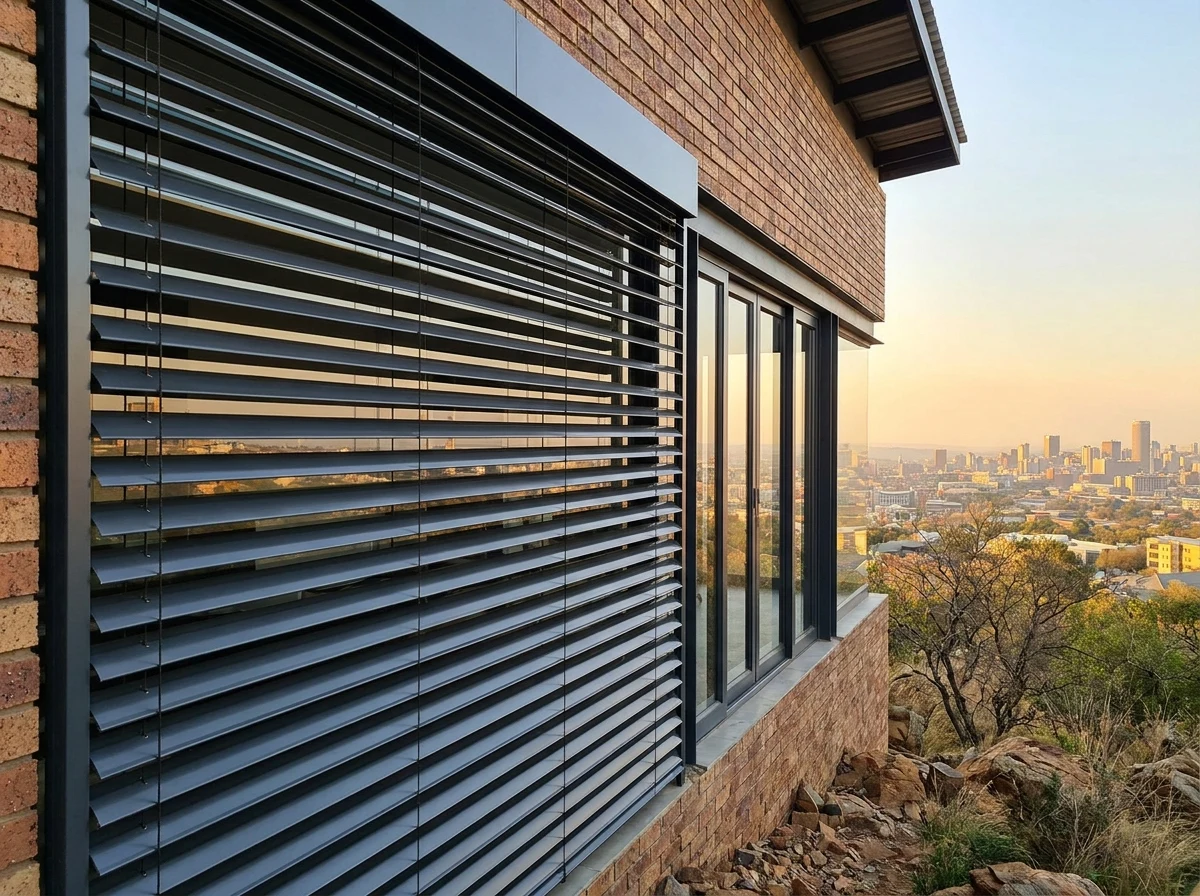
An external venetian blind mounted outside a wide sliding door on a Johannesburg ridge home, horizontal aluminium slats tilted against the afternoon sun with the city skyline visible below
Stopped outside the glass. On the hardest west-facing view wall, the slats do their work before the sun ever reaches the pane — the difference between a room that stays cool and one that radiates heat back all evening.
Optional

Want this marked up for your own house?

Tell us which rooms are giving you trouble and we'll send this guide back with your own elevations noted against it. It's an email, not a visit — nobody phones you about it.

POPIA note: your details are used only to send you this guide and, if you ask for it, to arrange your free in-home measure. Never shared with third parties.

04 — The specification

What we'd fit here, and the catch with each

Each is right somewhere on this ridge and wrong somewhere else. Tick anything that sounds like your problem — it carries into the form below.

Sunscreen roller blinds

View-facing glass · north through west

One flat sheet of open-weave mesh on a tube — no folds, no pleats. A 3–5% weave cuts glare and UV hard while the ridge stays visible through it.

The trade-off

It reverses after dark — the weave that lets you see out lets a lit room be seen into. Pair it with a blockout or a day & night blind where privacy matters.

External venetian blinds

The hardest west-facing view wall

Wide aluminium slats on a headbox outside the glass, tilting to filter the light before it reaches the pane. On a punishing west elevation we'd specify these over an interior blockout roller — stopping the sun before the glass keeps a room cooler than absorbing it inside, where the pane radiates heat back for hours after the sun has moved on.

The trade-off

The most visible change to the outside of the house — the headbox needs somewhere to live — and it sits outdoors through hail season.[9] Always motorised, always wind-sensored, on a ridge this exposed.

Blockout roller blinds

Bedrooms · east glass · media rooms

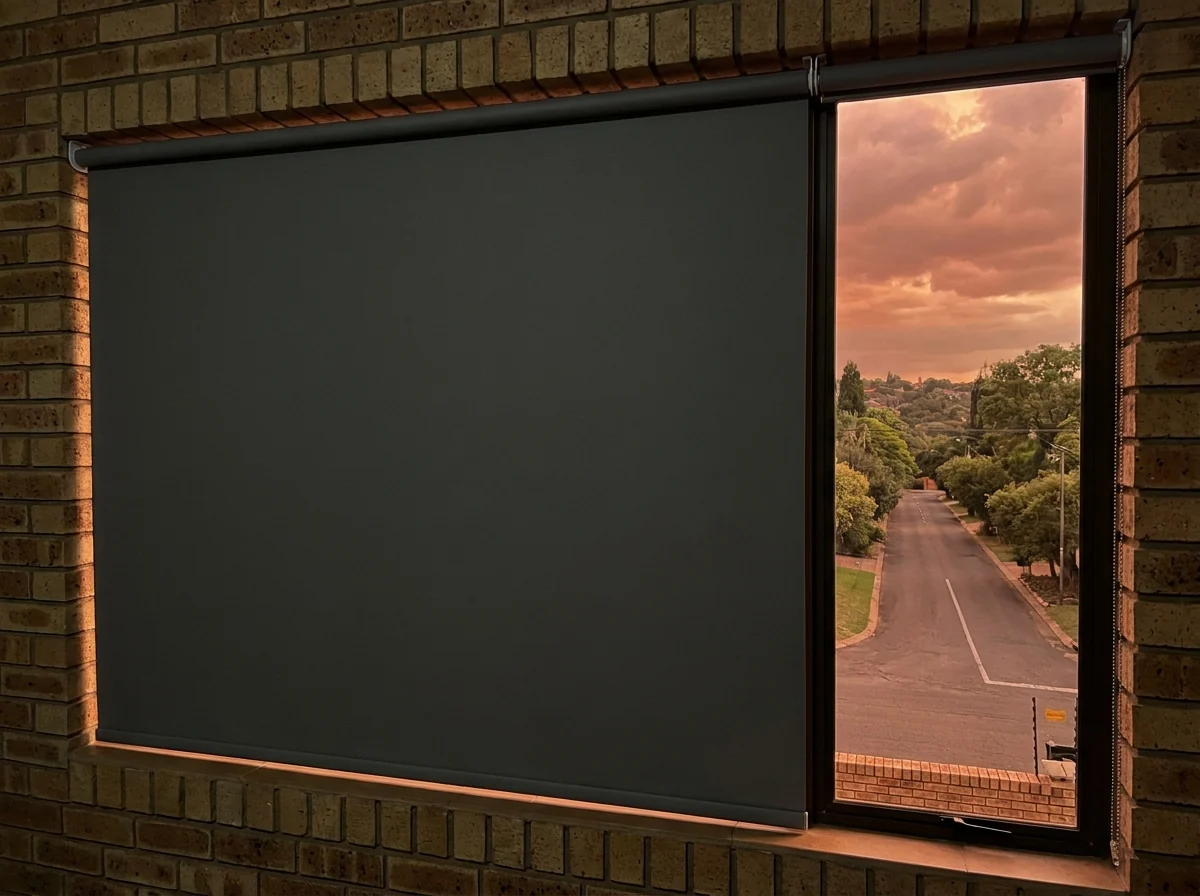
The same flat roller, in a fabric that stops light rather than filtering it. Against an early sunrise on an east bedroom, or a west room needing true dark, it's the most effective single product there is.

The trade-off

Binary — down is dark, up is everything — the wrong tool for a north room that wants winter sun back in June. Light still finds the edges of an unlined reveal.

Aluminium venetian blinds

View-facing living rooms · kitchens

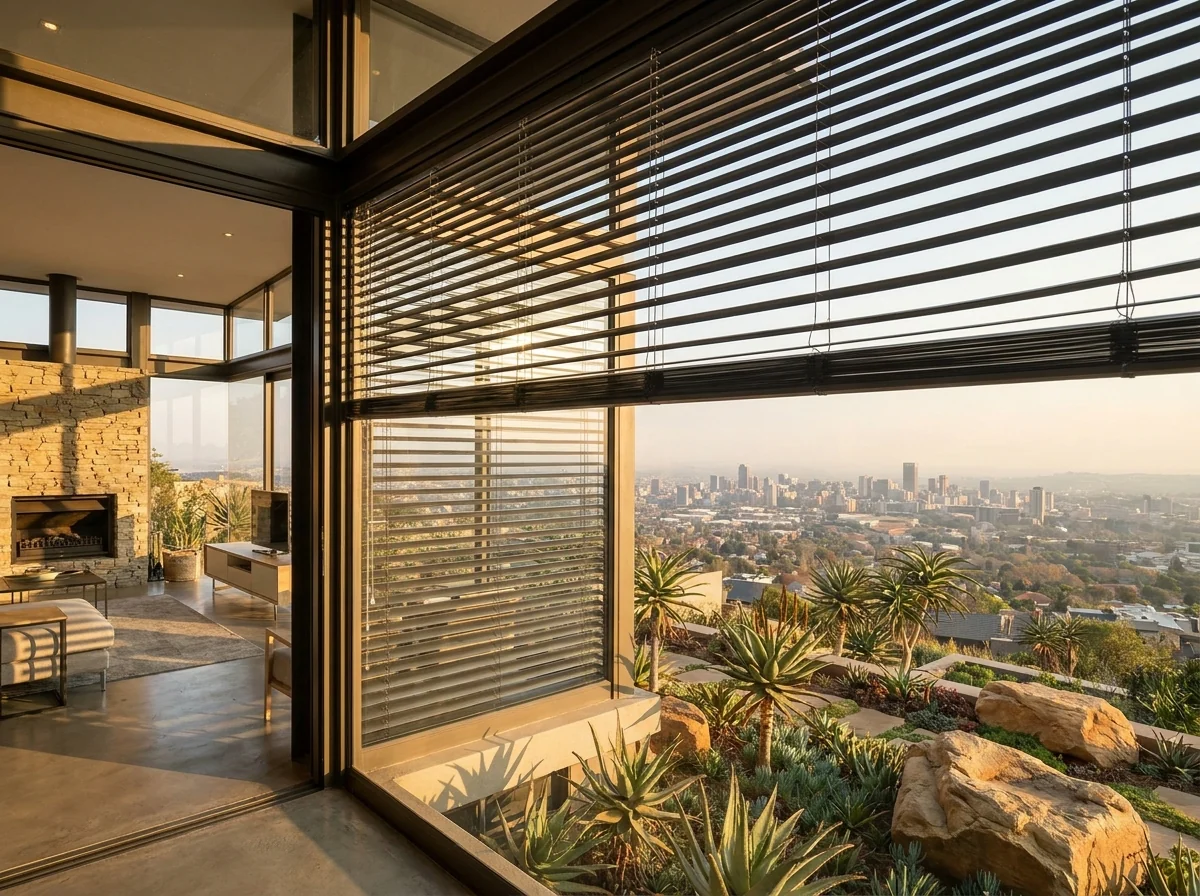
Horizontal slats you tilt by the degree instead of simply raising. Where the window's whole point is the outlook, that matters: tilt through the day and steer the light without losing the view a lowered roller costs you. Timber venetians do the same job in interior rooms away from direct weather.

The trade-off

Heavier and dearer than a roller, and a wide opening splits across two headrails. On an exposed, wind-borne-dust stand aluminium outperforms timber, which ages poorly against damp.

Day & night blinds

Street-facing bedrooms · boom-gate stands

Alternating sheer and solid bands on a single roller. Line the bands up for privacy from a street or a close boom-gate stand; offset them and the view comes back. Where a room also needs true dark, run a double roller instead — sunscreen or day & night on one bracket, blockout on a second.

The trade-off

More mechanism than a plain roller, so more that can eventually need adjustment, and it never goes fully blockout on its own.

Folding-arm awnings

The deck that looks out over the ridge

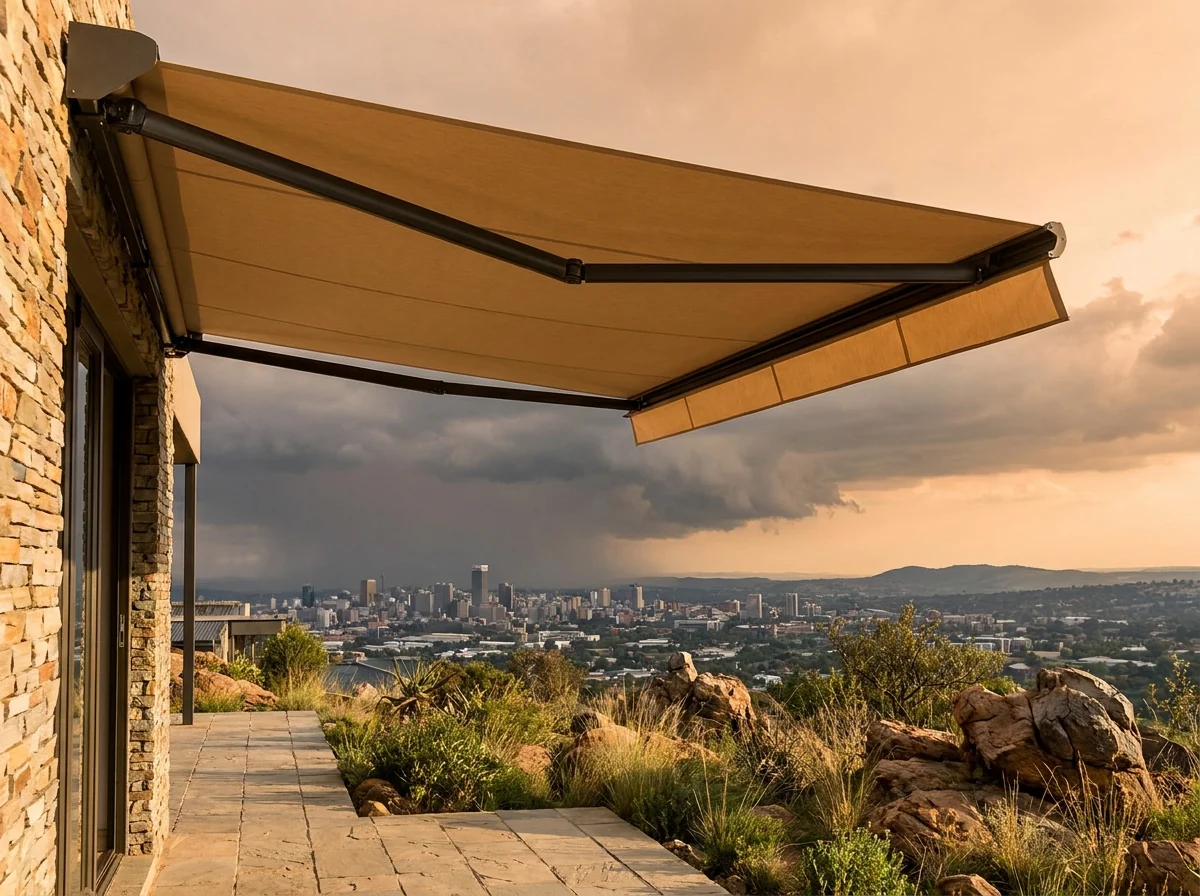
A fabric canopy on articulated arms that shades the deck in seconds and folds flat away for winter sun. On a stand built around the view, the deck often gets used more than any single room indoors, so shading it can buy real comfort.

The trade-off

Wind rating is a real limit on an exposed stand, not a suggestion — hail season on the Highveld runs October to March.[9][10] We'd always specify a motor with a wind sensor, retracting before a gust rather than after one.

Also in the range: timber venetians for sheltered interior rooms, cellular / honeycomb blinds for cold south rooms, vertical & panel blinds for wide openings, concealed / recessed systems, shaped & skylight blinds, roller shutters (shading) — not security-rated, a different product on request — zip screens for wind-exposed patios, motorised automation, and blind repairs.

Full-height living-room window on a Johannesburg ridge home, aluminium venetian blinds tilted to filter hard afternoon sun while the city skyline stays visible beyond the glass
Steered, not blocked. Tilting the slats through the day keeps the glare down without dropping a sheet across the one thing the room was built to show you.
05 — The local constraint

Boom gates, complexes, and the outside of the building

Northcliff itself is mostly freestanding stands, which is more freedom than a sectional-title scheme allows — but some streets on the ridge now run boom-gate access control,[1] and any street-level committee attached to that boom is worth a quiet check before an external product goes up. Further along the same ridge system, Weltevredenpark's newer cluster and sectional-title developments carry body-corporate rules on exterior appearance,[13] and both Blackheath and Windsor mix townhouse complexes in with freestanding homes.[14][15]

  • Interior blinds in an existing opening change nothing anyone else can see — almost never anyone's business but yours.
  • Exterior products — awnings, external venetians, roller shutters, zip screen channels — change the elevation. On a freestanding Northcliff stand that's your call alone; behind a boom or inside a complex, ask first.

And if the extension you're planning adds view-facing glass: SANS 10400-XA:2021 (Edition 2) requires a fenestration calculation once glazing exceeds 20% of floor area — it was 15% before — and no longer distinguishes the solar-heat-gain requirements of west, north or east glass.[16] We fit blinds, not compliance, so it's worth raising with your architect early how the shading gets counted.

06 — The honest limit of a guide

What we'd still need to check on site

Everything above is what we know about the ridge. What no guide knows is your house — and these four decide the specification.

Reveal depth, whether it's square, and what the wall is made of

Depth decides whether a blind fits inside the opening at all, and whether a headbox has anywhere to go. Original face-brick openings are rarely square — a centimetre top to bottom is normal. A steel-framed original casement, a newer aluminium slider and a glass extension's stud wall all take fixings differently.

Which way it really faces — and how exposed that spot on the ridge is

Twenty degrees changes the answer between west and north-west, so we take a compass reading at the window itself rather than guessing from the street. Then we look at the position: a stand tucked below the crest is physically more sheltered from wind than one sitting right against the exposed rock and grassland.

Where the power is, and who uses the room

For anything motorised the constraint is the route from a power point to the head of the window — a walk-around with a torch, not a guess. And a cot near a corded window changes the recommendation on the spot.

Fixing height and wind exposure on the deck

Awnings and external screens live or die on this. A sheltered courtyard and an exposed ridge-top corner want different products and sensor settings, and fixing height above the door governs how far one can safely project.

Bedroom window in a renovated face-brick ridge-top home with a blockout roller blind drawn against the setting sun, a steep tree-lined Northcliff street visible through a side gap
Down for the night. On the view side of the house, true dark still has to be a decision you make on purpose — the window that sells the house is the same one the sun sits on latest.
07 — Two ways forward

Book the free expert measure

A consultant comes to your home, measures every window on site, and leaves you a written quote per window. It costs nothing and commits you to nothing. Prefer a rough number first? The ballpark list under the form does that.

Free in-home measure and a written quote per window
No call centre — a real consultant comes out
Nothing is made until you've approved the quote
Still deciding? Say so, and we'll leave you be

Our consultant does five to six measures a week across this area, so book ahead if you need a particular day.

Anything you ticked while reading is already in the form.

What are you interested in? (tick any)
Want a ballpark figure first? Open this — about two minutes.

Northcliff Blinds — window list

Walk the house, fill this in by hand, then type it into the form on northcliffblinds.co.za when you get back. Measure the width first, then the drop, in millimetres.

Pop in rough sizes and we'll send a budget range by the next working day. Not sure how to measure? Leave it blank — our consultant measures for free and you'll get exact per-window pricing either way. This is entirely optional and nothing here is binding.

Room Width (mm) Drop (mm) Inside or outside the reveal Product Remove

Nothing on the list yet — and it stays entirely optional.

Anything you enter here travels with your enquiry as plain text. No uploads, no third-party services, nothing stored anywhere else. If photographs would help, a consultant will simply ask for them in the reply.

POPIA note: your details are used only to arrange your free in-home measure and consultation call-back, and are never shared with third parties. If you tell us you're still researching, we won't phone you.

Neither, for now

Just take the guide, marked up

Not ready for a visit or a number? Tell us which rooms are the problem and we'll email this guide back with your own elevations noted against it.

Used only to send you the guide. Never shared with third parties.

A folding-arm awning extended over a paved deck on a Johannesburg ridge home, the city skyline below and a highveld thunderstorm building behind the ridge
The deck question. Projection, fixing height and wind exposure get decided standing on the paving — and on the Highveld the storm is part of the specification.
Working out

Sources

Every climate, geography, suburb and regulation claim above traces back to one of these. Where we've reasoned from trade experience or plain topography instead of citing something, we've said so in the text.

  1. Area and property guide to Northcliff — established as a suburb in 1934; northern-slope stands prized for a warmer, sunnier winter while higher stands orient toward the panoramic outlook with full-height glazing and little natural shading; narrow, winding, steeply graded streets with low garden walls angled to preserve view lines, some now with boom-gate access control; resale stock a mix of original face-brick homes (many renovated with modern glass extensions) and contemporary rebuilds. privateproperty.co.za — Northcliff area guide
  2. At 1,807 m, the NorthCliff Tower Ridge is the second-highest point in Johannesburg, one metre lower than Observatory Ridge (1,808 m). City of Joburg — official post
  3. Northcliff Ridge Ecopark — hiking trails across exposed rock outcrops and indigenous vegetation, home to birds of prey; the ridge was historically named Aasvoëlkop ("Vulture Ridge"). myguidejohannesburg.com — Northcliff Ridge Ecopark
  4. The 1939 water tower on Northcliff Hill remains a landmark visible from the ridge trails. cityofjoburgblog.wordpress.com — a hike at the burbs of Northcliff
  5. Northcliff borders Cresta Shopping Centre, with the N1 Freeway and Beyers Naudé Drive as its main access routes. en.wikipedia.org/wiki/Northcliff
  6. "Sun, shade and natural daylight in South African town planning, with emphasis on Pretoria" — solar noon altitude of 87.7° on 21 December and 40.84° on 20 June, a December sunset azimuth of 243.35°, and the finding that afternoons on a western exposure run far hotter than the mornings. scielo.org.za — S2415-04952018000200005
  7. Independent solar figures calculated for Johannesburg (latitude −26.2°): peak altitude of about 87.2° at the December solstice and about 40.4° at the June solstice. geotimedate.org — Johannesburg sun path
  8. Johannesburg rainfall by month — July the driest at around 3.6 mm, December the wettest at roughly 140 mm, out of about 779 mm a year. weather-and-climate.com — Johannesburg rainfall
  9. Hail in South Africa — most common in the summer-rainfall regions between October and March, peaking around November, with events most frequent from early afternoon into early evening; large hailstones can fall at over 160 km/h. southafrica.co.za — Hail in South Africa
  10. The Highveld — Gauteng, Mpumalanga and parts of the Free State — is especially prone to intense afternoon and evening thunderstorms between October and March. Daily Maverick — Highveld storm season looms
  11. The Highveld sits 1,200–1,800 m above sea level; high atmospheric pressure produces largely cloudless skies which, combined with the altitude, lead to high levels of ambient solar ultraviolet radiation. en.wikipedia.org/wiki/Highveld
  12. Wright et al., "Solar Ultraviolet Radiation, Skin Cancer and Photoprotective Strategies in South Africa", Photochemistry and Photobiology (2023) — ultraviolet intensity rising with altitude, and South Africa's high ambient UV levels. onlinelibrary.wiley.com — php.13676
  13. Weltevredenpark area profile — a mixed suburb of freestanding homes alongside numerous cluster and sectional-title developments, with body-corporate rules governing exterior appearance. seeff.com — Weltevreden Park
  14. Blackheath area profile — a genuine mix of freestanding freehold homes and sectional-title townhouse/apartment complexes. century21.co.za — Blackheath
  15. Windsor East area profile — predominantly apartments, townhouses, duplexes and semi-detached dwellings, with a smaller share of freestanding homes. seeff.com — Windsor East
  16. SANS 10400-XA:2021 (Edition 2) — the fenestration-calculation threshold rising from 15% to 20% of floor area, and the removal of any distinction between the solar-heat-gain requirements of glazing facing west, north or east. roosarchitects.co.za — the revised SANS 10400-XA

Two honest caveats. The solar figures in source 6 are calculated for Pretoria at about 25.7° south; Northcliff sits at roughly 26.2° south, so its own angles differ by well under a degree — we've quoted the published numbers rather than invent our own, and source 7 is there as a direct Johannesburg cross-check. And no wind-speed dataset specific to Northcliff Hill itself could be found — the note above about the ridge crest being more wind-exposed than a sheltered stand lower down is a reasonable reading of the topography, not a measured figure, and the guide treats it as such.

Next Step

Now let's look at your actual windows.

A free in-home measure, a written quote per window, and a real conversation about the rooms that are giving you trouble.