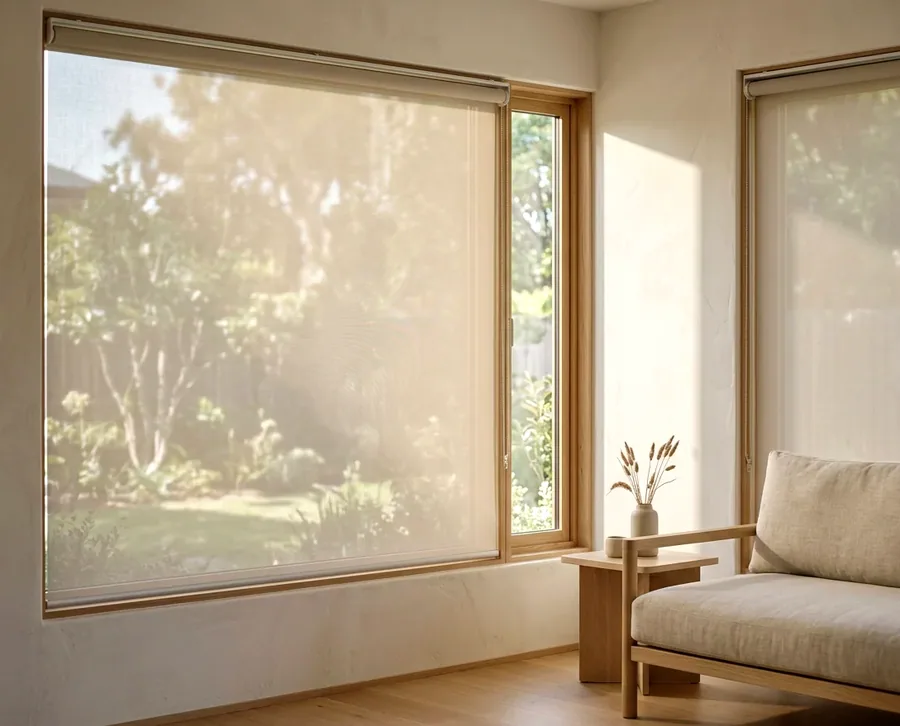
One flat panel of fabric on a tube, cut to the millimetre. On a Northcliff view wall the fabric does all the work — a mesh that keeps the skyline, or a blockout that ends the day when you say so.
Every roller quote on the ridge starts with a compass question, not a colour question. Which way does the glass face?
West over the valley, where the late sun lands full on the view wall: that glass wants a dense sunscreen weave, chosen to tame glare without deleting the reason you bought the house. South-facing kitchen or scullery glass gets soft, even light all day and can carry a much more open weave — or none at all. Street-facing bedrooms are a privacy call first and a light call second, and that usually means blockout. Only once each opening has a job description do we open the sample books.
Here's the counter-intuitive part of sunscreen fabric: a charcoal or bronze weave gives you a clearer view than a white one. Dark yarn swallows the reflections on your side of the glass, so the mesh reads almost transparent from indoors; pale yarn bounces light around and turns the skyline milky. White weaves do reflect a little more heat — that's the honest trade — but on a Northcliff view wall we'll usually argue for the dark fabric and deal with heat by other means. Judge the samples in your own room, late in the afternoon, before deciding.
The fabric itself passes no light. The edges are another story. A blind fitted inside the window reveal always carries a small gap either side of the fabric, and on a bright Highveld morning that gap draws two neat stripes of light down your bedroom wall.
So we fit blockout with the gap in mind: oversized outside the reveal where the wall allows it, or inside the reveal with the fabric run as close to the plaster as the mechanism permits. Bedrooms that face the view get the double-bracket treatment — sunscreen and blockout sharing one bracket, so the skyline is there at breakfast and gone by lights-out.
Standard control is a chain with a child-safe tensioner anchored to the wall. Spring-assist lightens the pull on bigger drops. And anything wide, high or repeated — a full run of view glass, clerestory panes above a staircase — is a case for motorised control, one press for the lot.
Rollers are quoted per square metre, installed. Manual — chain or spring, in sunscreen, blockout or a light-filtering weave — runs R1,000 to R1,600 the square metre, with the premium mesh weaves and double-bracket pairs near the top. Motorised, the same opening comes to R2,500 to R3,800, which carries the tube motor, the control and the setting up on the day.
A small opening is charged at a minimum rather than by area, because a cloakroom window takes the same tube, brackets and fitting time as a wall of view glass. Those bands are for planning only — the number for each of your own windows comes out of the free measure, in writing, before anything is made.
Rollers travel well. The same blind we hang on a ridge view wall suits a Fairland family room or a Windsor townhouse, and the measure-first routine doesn't change from one suburb to the next.
A free measure takes under an hour, and the quote that follows is written per window — accept some, all, or none of it.